
Helping Solutions, for context, is a Registered NDIS provider in Perth, WA, offering Support Workers and Specialist Disability Accommodation. Support Workers are more than just companions; they enable people with disabilities to live their lives with more choice and control, assisting with daily living tasks, personal care, community access and more.
If you’re living with a disability and have recently acquired an NDIS Plan, you can now approach an NDIS support provider (such as Helping Solutions, Perth WA) to purchase supports that will assist you in pursing your life goals.
But you might be wondering… what are the NDIS support categories that I can choose supports from?
There are four categories which include:
- Core supports
- Capital supports
- Capacity building supports
- Recurring supports
Assistance with Daily Living falls under Core Supports.
What is Core Support in the NDIS?
Core Supports exist to support NDIS participants to live a better quality of life and build capacity towards various goals that they have set.
These goals can include daily living activities (Assistance with Daily Living) as well as community access and social activities (Community Participation).
Assistance with Daily Living – NDIS support budgets
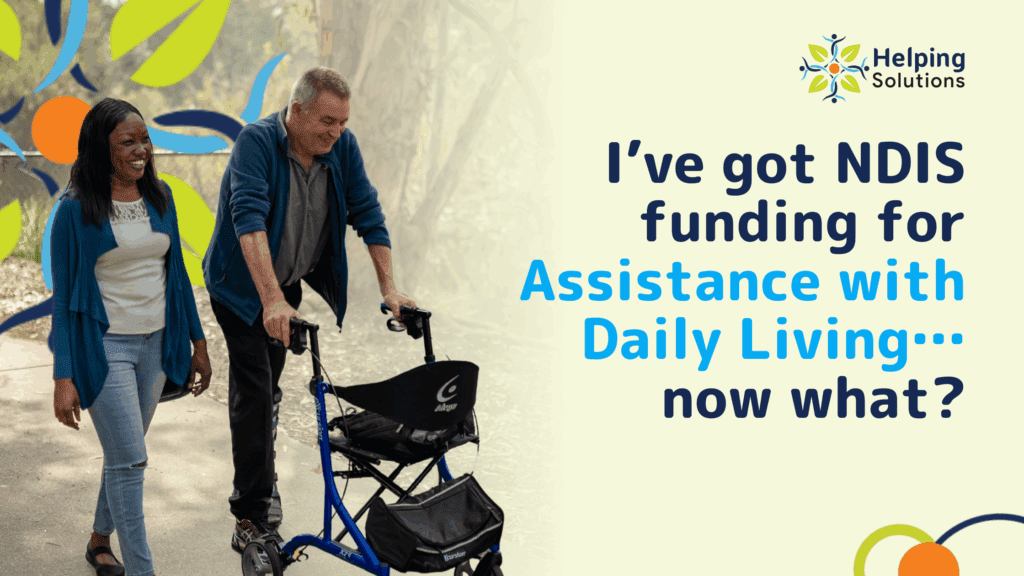
If you’re wondering what you can put your Assistance with Daily Living budget towards, we’ve created a comprehensive list of options below which outline different things to think about, based on what we’ve seen benefit our existing participants.
1) Personal care routine
If one of your goals is to create a personal care routine so that you can shower, dress and look after your hygiene needs more independently, this is something you can get Assistance with Daily Living support for.
We’ve seen participants approach this from multiple angles. For some, their goal is to receive a level of support that meets their essential needs, since showing or dressing independently is not currently possible for them.
For others, it’s something they’re in the process of building ability towards—so they receive support around these activities with the intention of eventually being able to do it on their own.
There are no right or wrong approaches. It’s purely dependent on your individual goals, what this gives back to you and what you want to be able to do with your life a year from now.
2) Routine household tasks
Another goal many of our participants work towards is managing weekly, routine tasks that keep the home feeling tidy, fresh and easy to navigate.
This might be one of your goals if you desire to eventually live on your own, or with housemates, and want to feel confident and capable of managing household responsibilities.
Some of our participants receive support with cleaning and laundry as they have reduced mobility, and their environment doesn’t currently offer adaptive supports and solutions (e.g. adjustable furniture, wider hallways and doorways, etc.)
For other participants, they’re building ability to be able to manage more tasks with reduced help so that they can eventually transition to more independent living arrangements.
3) Meal preparation
Preparing meals is a big one. There are so many factors that can impact a person’s ability to prepare nutritious food consistently—from reduced mobility to psychosocial factors. That’s why many of our participants receive support with different aspects of meal preparation.
For some, they receive support with chopping vegetables, using hot appliances, or mixing foods.
For others, the companionship helps guide them through the decision-making process and follow the outlined recipe steps.
There are even some participants who are learning adapted cooking methods, and their support worker provides assistance to find new ways to prepare food that suit their current abilities.
How to register for NDIS support
If you don’t yet have an NDIS Plan, read our handy guide on submitting an NDIS support application.
4) Transportation
Everyone has responsibilities and reasons for needing to access the community—whether it’s doing a grocery shop or attending personal appointments.
Many of our participants are supported to attend their daily obligations and build confidence and capacity to be able to access the places that they need to go.
For some of our participants, they are supported in their physical ability to get to and from places (be it due to mobility or planning and coordination). For others, it’s the emotional companionship that ensures they feel safe and guided to do the things they need to do.
5) Health and wellbeing
Finally, Assistance with Daily Living budget can go towards supporting and maintaining your health. This can look like medication management, attending medical appointments or fitness commitments, or even receiving in-home care.
A common goal among our participants is receiving support to take their medication on time—some people need regular reminders, while others need help administering it.
At Helping Solutions, our support workers are trained by our nursing team to assist with routine medical care needs, reducing the need to outsource additional nursing support.
This aspect of our service also supports our participants to reduce the impact of their disability and maintain the ability to continue doing the things they love doing.
Can NDIS support workers administer medication?
At Helping Solutions, our dedicated nursing team ensures your support workers are thoroughly trained in the use of various types of equipment and medication administration, enhancing your overall comfort and care.
This includes (but isn’t limited to):
- Changing dressings and tending to your wounds
- Administering injections and regular medications
- Performing checks and monitor any complications
- Caring for catheters and/or stoma bags
What can’t you put budget towards?
Because the NDIS does not fund day-to-day living costs that everyone has to pay for, there are certain items that are not funded. Here’s a comprehensive table to help you compare the difference:
| Category | Funded by NDIS | Not funded by NDIS |
| Food | Additional cost of meal preparation & delivery (e.g., for people who cannot prepare meals themselves)
Enteral feeding formula (for participants requiring tube feeding) |
Everyday groceries (including ingredients for home meals) and takeaway meals
Restaurant dining
|
|
Example: |
You can get funding for support to cook a pizza, but you cannot fund a takeaway or dine out pizza.
|
|
| Home | Support worker to assist with routine home tasks.
|
Cleaning, household and health products
Rent, board and mortgage payments. |
|
Example: |
You can get funding for assistance with doing laundry, but you can’t fund a housekeeper or fund the cost of laundry detergent.
|
|
| Recreation | Support worker to assist with participation (e.g., helping a person with disability engage in an activity)
Adaptive equipment needed for participation (e.g., modified sports wheelchairs)
Disability-specific recreational programs (e.g., art therapy, sensory-friendly events) |
Standard entry fees (e.g., concert tickets, amusement park passes)
General hobby materials (e.g., craft supplies, books) Personal expenses during activities (e.g., food, souvenirs) |
|
Example: |
You can get funding for support to play cricket, and fund adaptive equipment for cricket, but you cannot fund tickets to attend a cricket game.
|
|
| Personal Care | Assistance with daily activities (e.g., showering, dressing, toileting)
Consumables (e.g., continence products, adaptive hygiene equipment) Support worker for personal care tasks. |
Cosmetic treatments (e.g., facials, haircuts)
Personal items, toiletries and cosmetics Services not related to disability needs (e.g., massages for relaxation rather than therapy) |
|
Example: |
You can get funding for support with toileting and brushing your hair, but you cannot fund the cost of feminine hygiene and/or makeup products.
|
|
Supporting you to achieve your goals in 2025
We hope this article has helped clarify what you can put your Assistance with Daily Living budget towards.
If you’re ready to start receiving Assistance with Daily Living supports, and you’re interested in learning about how Helping Solutions could support you, then get in touch with our friendly and caring team today.
Phone: 1300 905 166
Email: [email protected]